Samsung Galaxy S9: Still the Lord of All Droids
Samsung Galaxy S9: Still the Lord of All Droids

There’s a lot to be said for not buggering up a winning formula. And there’s something to be said in 2018 for a premier brand. Samsung's Galaxy S9 is the best all-round Android phone you can buy.
You’ll find phones that can do most of what it does that are much cheaper, and nothing depreciates faster than a Samsung Galaxy - that’s official. But consider the whole deal: the style, the after-market support, the accessories, the care taken with the product, and the coherence of the whole thing - and Galaxy is top of the pile.
And that’s even after noisy neighbour Huawei has barged into the smartphone premier league so noisily beating its chest. And you notice the Bixby button is still there.
In fact Samsung's biggest competitor, now that people hang on to their phones for ages and SIM-free deals abound, is Samsung itself. If you're upgrading from three years ago you probably won't think twice. Otherwise, if you're coming from a recent competitor, the Samsung S8 Galaxy offers much the same proposition for much less.
The Galaxy S9 also deserves its place at the top of the pile for the dozens of small considerations. For a Google or a Motorola, the philosophy is to muck around as little as possible with Android, which is fine, and a lot of you appreciate that. But with something in the “premium” price bracket, why not make an effort? Samsung does, and it does so in a much more restrained way than it used to. For example, the Edge Panel, which slides over from the side, is genuinely useful, and became my app/person switcher. And for something closer to a grand than £500, why shouldn’t it have Qi and waterproofing?
And it’s done this without creating a fricking notch. It should get a Posh Design Award just for that.
In a nutshell, the design is almost identical to last year’s Galaxy S8, with the fingerprint sensor positioned in a slightly (but not a lot) more sensible position. And a new imaging rig - which we'll get to in a bit.
It’s a millimetre longer and thanks to a sturdier aluminium frame, half a millimetre fatter - which isn’t noticeable. The default is still 64GB of storage, and 4GB of RAM, and the non-removable battery remains at 3000mAh. So it’s really the same, but a bit faster.
The big change to the out-of-the-box user experience this year over last year is that Bixby is not "in yer face" the whole time. A year ago I described The S8+ as “like a nine-course meal of desserts – tiramisus, trifles, ice creams, one after another – that you have to eat with chopsticks and a straw.” Bixby was half the problem.
Bixby was an AI assistant launched with great fanfare at MWC 2017. Samsung would understand what you were saying, identify things, and be a general helpful puppy. Samsung gave Bixby a dedicated button: something the camera didn’t get. US English voice support was months late and UK English not at all. The benefits of this feature were occasionally tangible, often half-baked, and rarely appreciated. Bixby Voice didn’t support UK English.
Samsung had committed the Clippy The Paperclip crime of thrusting unwanted intrusions at you when they were not needed. For a while, it brazened it out: No, you Can Not turn off Bixby.
Eventually the Korean giant realised that this feature, with its dedicated button, was not helping, so made it easier to disable. Bixby makes a half-hearted attempt for your attention, then largely gives up. Once you’ve turned it off, Bixby really won’t bother you again.
With the S9, Bixby can actually begin to do useful things - at least things some of you may find useful, like deep integration into the system to access settings or complete actions: something Motorolablazed a trail with. But Bixby still won’t support UK English. I wish the other “assistants” were as easy to disable, and perhaps in the post-Facebook meltdown era, punters will be a bit smarter about what data they surrender.
Alas, I found the placement of the fingerprint sensor underneath the camera to be a little better - but still too close to the camera itself, resulting in unwanted smudges. A centimetre would have made a big difference, making it easier to reach too. If practically everyone else can do it, I can't see why Samsung can't.
Overall you'd be hard pressed to find many differences in this year's over last year's UX. Samsung has toned down the aggressive TouchWiz UI over the years, and even more so since it introduced a new design language it calls "Grace UX" in mid-2016. So, a Samsung shipping today no longer boasts an S-this or S-that. In fact, things that should or justifiably could be bundled - like the S-Finder search app and Samsung's really rather excellent version of Garageband, Soundcamp - are optional downloads. There's still some duplication: Samsung wants your images in Samsung's cloud, and so does Google. But less than before. For the first time that I can recall on a Galaxy, I wasn't prompted to download Google Play Services.
I do wish Samsung would bundle a few more themes, or pay quality theme designers to include a couple in its Theme store for free. Most of what's in the Samsung store is whimsical, and costs money. For those determined to purge the S9 more thoroughly, there's a guide here.
The Samsung browser continues to improve, touting a night mode, and with a couple of clicks you can install an ad-blocker. I noticed the Samsung password service being pushed hard this year.
The Device Maintenance app introduced in Android 7.0 is more prominent, and offers a dashboard for the power saving profiles and cleaning up the system.
Samsung does push its Pay app, and this has genuine advantages over Google and Apple's payments setup - but over a year after launch it still doesn't work with Barclays, Lloyds or other important retail banks.
The regular S9 turns out to be no poor relation, then - this is an excellent smartphone camera, marred only by gimmicks and a confused UI.
The main shooter has a mechanical aperture which alternates between two settings: f/1.5 and f/2.4, the former allowing much more light to be captured in dark conditions. It’s a peculiar gimmick, as almost all the time the shutter is closed, in f/2.4 mode, and only opens up in the dark.
I won’t provide a comprehensive in-depth head-to-head to see how the S9 fared against the latest iPhone, the Pixel 2 XL and the Huawei P20 Pro - that’s coming - but the results were very impressive, putting the S9 in the top tier in many situations. To be honest, you’d be surprised to discover anything else, given the knowledge and resources Samsung has. It is only emphasised here given the noise that Huawei has been making - touting a highly dubious DxO score. In situations where I compared the two, the S9 usually won out, with more balanced photos. It’s the better all rounder.
The photos below are tempered by the gloom - not one is taken in bright, sunny conditions. But in situations where over-sharpening has tripped up many a phone camera - the notorious firs - the S9 resolves the detail reasonably well. You’ll see an artefact in the night time shot, and the 2x zoom is pretty awful. But it generally acquits itself well.
Where I’d fault the camera is its confusing UI. It used to be so simple and well thought out, but the internal Department of Gimmicks has been influencing the Camera app design and it’s now a very modal interface. Without exception, everyone I handed the S9 to found themselves in an unfamiliar mode. It’s understandable that Samsung wants to thrust its novelties (like super low mo) and AR emojis at users, but not to the detriment of everyday use.
So the horizontally scrolling modes are now: Food - Panorama - Pro - Selective Focus -Auto [default] - Super Slow-Mo - AR Emoji - Hyperlapse.
Phew. Bear in mind that horizontal swipes translate to a vertical swipe in landscape mode - meaning the phone switches to using the selfie camera. Used in the real-world it’s a real mess. Samsung now has the most confusing camera app of any phone maker, and you can’t simplify it by removing options you rarely use.
I noted lots of positives, though. Portraits came out superbly, without too much smoothing. OIS works great producing nice, stable video even at higher resolutions. The super slow mo (at 960fps) mode is now motion activated, as it always should have been. You’ll need very good light to enjoy it, though - it’s one area where Huawei’s P20 models are actually superior.
It’s a sad reflection on the media that with such a good camera, Samsung thinks it needs to put an emphasis on gimmicks to get attention. Last year it was live stickers - goofy real-time overlays over the photos. Kids loved it. This year’s gimmick is the AR emoji that Apple introduced last year. Kids love it too, it’s great fun. But it’s a feature that shouldn’t be in your way.
That said, my own AR Emoji came out so flattering that I've requested they be used on my UK Passport from now on. Fingers crossed, eh, dear readers.
Call quality was outstanding, and it maintained an LTE signal well. Voda has quietly improved its network and this is noticeable around London. While EE has the most spectrum, and advantages of scale, it has work to do with reliability and not dropping calls.
Hardly any phone reviews include any remotely scientific RF testing. Ideally, I'd like to see Ofcom conduct this kind of research on handsets, and publish it in a consumer-friendly format regularly, so we could refer you to it.
Now onto the sound.
Europeans get a Cirrus Logic CS43131DAC for the audio - details here - US variants of the S9 use a Qualcomm SoC rather than Samsung's own SoC, and so use the Qualcomm WCD9341 audio chip instead.
Both Samsung and Apple have some work to do satisfy audiophiles with the quality that LG can offer.
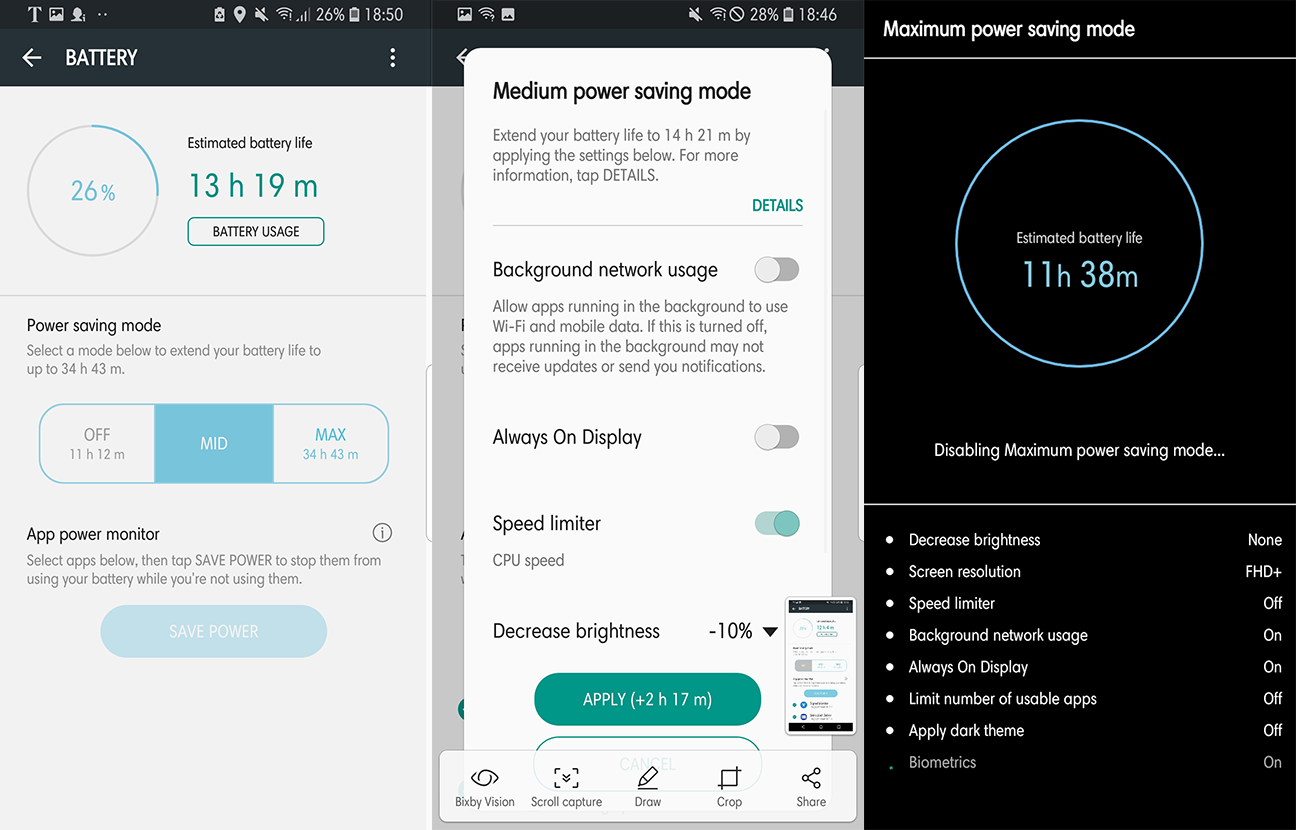
So how does battery life hold up? The power pack is very much the same as last year's. It's adequate without being a champ. Samsung is evidently keenly aware of this, as it scales back the maximum resolution of the display. The power profiles offer further savings, and there's a featurephone mode for emergencies.
You’ll find phones that can do most of what it does that are much cheaper, and nothing depreciates faster than a Samsung Galaxy - that’s official. But consider the whole deal: the style, the after-market support, the accessories, the care taken with the product, and the coherence of the whole thing - and Galaxy is top of the pile.
And that’s even after noisy neighbour Huawei has barged into the smartphone premier league so noisily beating its chest. And you notice the Bixby button is still there.
In fact Samsung's biggest competitor, now that people hang on to their phones for ages and SIM-free deals abound, is Samsung itself. If you're upgrading from three years ago you probably won't think twice. Otherwise, if you're coming from a recent competitor, the Samsung S8 Galaxy offers much the same proposition for much less.
Click to enlarge
Look, feel and features
First off, the Galaxy S9 really must be one of the most beautiful consumer products ever made. It’s what you wanted the future to look like when you were watching Tomorrow’s World in the 1970s. Only the future turned out to be billions of generic boxy rectangles. The S8 and S9 are emphatically not boxy rectangles, and it’s as pleasing to find something as nice to hold as it is to look at. That was never really true of another modern classic, the great Apple iPhone 4 design (now reincarnated as the iPhone SE).For something closer to a grand than £500, why shouldn’t it have Qi and waterproofing? And it has done this without creating a fricking notch. It should get a Posh Design Award just for that.You'll know by now that the Galaxy S9 is practically identical to last year’s S8, and Samsung's curved glass displays have been on the market since 2015. But I feel this can’t be emphasised enough: with prices creeping up to £1,000, at leastSamsung offers you something that looks and feels like luxury. The Samsung S9’s OLED display is still the best. Until LG starts to notch up some design wins for its curved OLED panels, it’s going to remain so. As with last year’s S8, the screen is even better than it appears out of the box, as Samsung has reduced the resolution to save power. You can crank it up too.

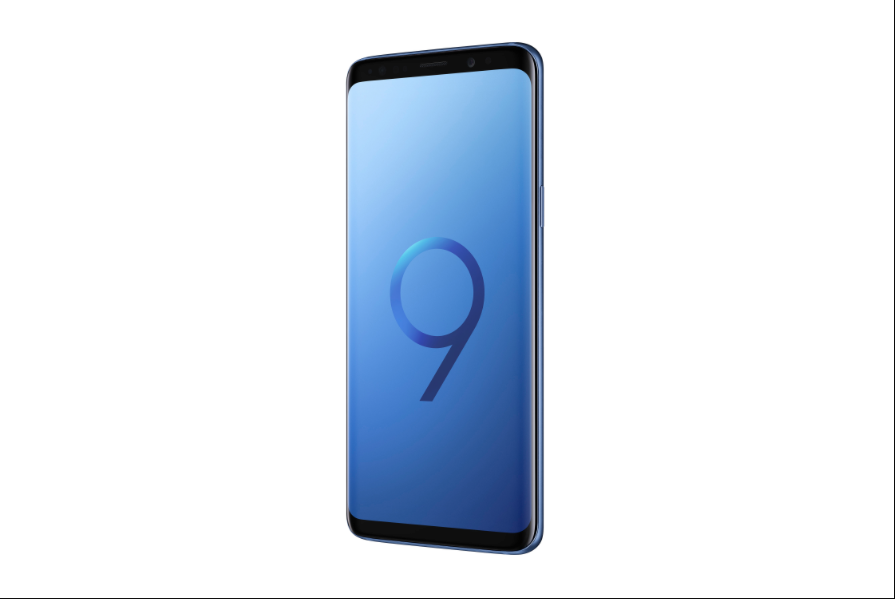
In real life, the Lilac variant is a lot nicer than it looks in this Samsung marketing render, being a bit darker
And it’s done this without creating a fricking notch. It should get a Posh Design Award just for that.
In a nutshell, the design is almost identical to last year’s Galaxy S8, with the fingerprint sensor positioned in a slightly (but not a lot) more sensible position. And a new imaging rig - which we'll get to in a bit.
It’s a millimetre longer and thanks to a sturdier aluminium frame, half a millimetre fatter - which isn’t noticeable. The default is still 64GB of storage, and 4GB of RAM, and the non-removable battery remains at 3000mAh. So it’s really the same, but a bit faster.
Bye bye Bixby, Bye Bye
Click to enlarge
Bixby was an AI assistant launched with great fanfare at MWC 2017. Samsung would understand what you were saying, identify things, and be a general helpful puppy. Samsung gave Bixby a dedicated button: something the camera didn’t get. US English voice support was months late and UK English not at all. The benefits of this feature were occasionally tangible, often half-baked, and rarely appreciated. Bixby Voice didn’t support UK English.

"Please smear the camera lens with your finger"
(It doesn't quite say).
(It doesn't quite say).
Eventually the Korean giant realised that this feature, with its dedicated button, was not helping, so made it easier to disable. Bixby makes a half-hearted attempt for your attention, then largely gives up. Once you’ve turned it off, Bixby really won’t bother you again.
With the S9, Bixby can actually begin to do useful things - at least things some of you may find useful, like deep integration into the system to access settings or complete actions: something Motorolablazed a trail with. But Bixby still won’t support UK English. I wish the other “assistants” were as easy to disable, and perhaps in the post-Facebook meltdown era, punters will be a bit smarter about what data they surrender.
Alas, I found the placement of the fingerprint sensor underneath the camera to be a little better - but still too close to the camera itself, resulting in unwanted smudges. A centimetre would have made a big difference, making it easier to reach too. If practically everyone else can do it, I can't see why Samsung can't.
Software and features

Click to enlarge for stitched images of the Settings and Advanced Features panels

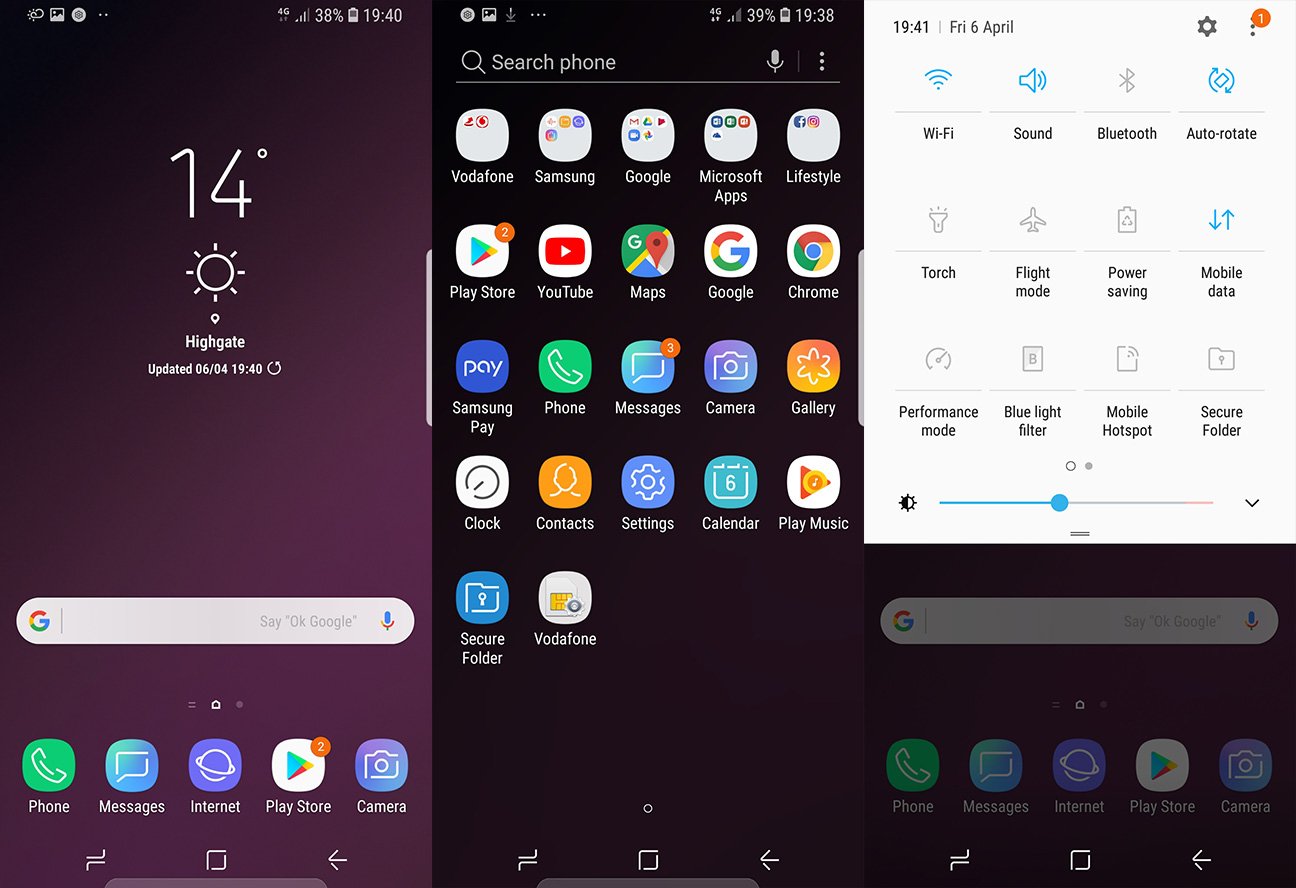
Less bloat than ever this year.
The Samsung browser continues to improve, touting a night mode, and with a couple of clicks you can install an ad-blocker. I noticed the Samsung password service being pushed hard this year.
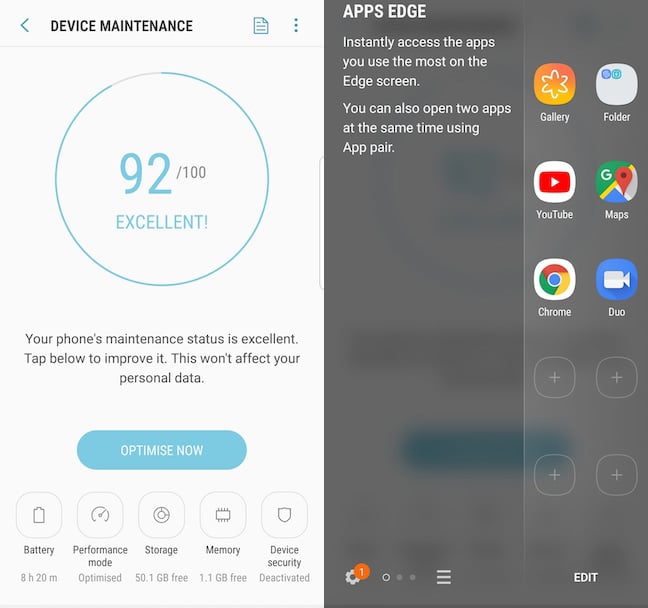
The Device Maintenance app introduced in Android 7.0 is more prominent, and offers a dashboard for the power saving profiles and cleaning up the system.
Samsung does push its Pay app, and this has genuine advantages over Google and Apple's payments setup - but over a year after launch it still doesn't work with Barclays, Lloyds or other important retail banks.
Click to enlarge
Imaging
Samsung didn’t change its imaging hardware from the Galaxy S7 to S8, and after Google introduced the Pixel 2 last year it needed a step change. The camera is the only big thing that’s new here in the Galaxy S9. The larger and more expensive S9+ has an extra sensor. The extra telephoto sensor is so rarely used, you’re basically using the same hardware most of the time.The regular S9 turns out to be no poor relation, then - this is an excellent smartphone camera, marred only by gimmicks and a confused UI.
The main shooter has a mechanical aperture which alternates between two settings: f/1.5 and f/2.4, the former allowing much more light to be captured in dark conditions. It’s a peculiar gimmick, as almost all the time the shutter is closed, in f/2.4 mode, and only opens up in the dark.
I won’t provide a comprehensive in-depth head-to-head to see how the S9 fared against the latest iPhone, the Pixel 2 XL and the Huawei P20 Pro - that’s coming - but the results were very impressive, putting the S9 in the top tier in many situations. To be honest, you’d be surprised to discover anything else, given the knowledge and resources Samsung has. It is only emphasised here given the noise that Huawei has been making - touting a highly dubious DxO score. In situations where I compared the two, the S9 usually won out, with more balanced photos. It’s the better all rounder.
The photos below are tempered by the gloom - not one is taken in bright, sunny conditions. But in situations where over-sharpening has tripped up many a phone camera - the notorious firs - the S9 resolves the detail reasonably well. You’ll see an artefact in the night time shot, and the 2x zoom is pretty awful. But it generally acquits itself well.

Click to enlarge
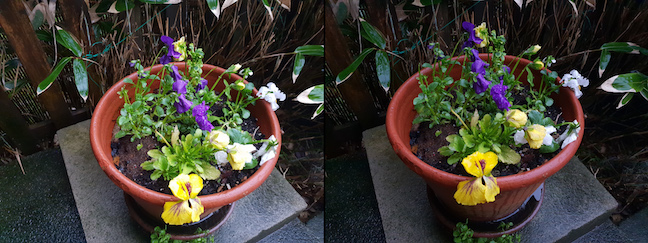
Brightness -0.9 (left) / 0.94 (right); Exposure time 1/25 (left) 1/38 (right); ISO 320 (left) ISO 250 (right); Shutter speed 1/35 (left) 1/50 (right); Click to enlarge

Click to enlarge
Click to enlarge
Click to enlarge
So the horizontally scrolling modes are now: Food - Panorama - Pro - Selective Focus -Auto [default] - Super Slow-Mo - AR Emoji - Hyperlapse.
Phew. Bear in mind that horizontal swipes translate to a vertical swipe in landscape mode - meaning the phone switches to using the selfie camera. Used in the real-world it’s a real mess. Samsung now has the most confusing camera app of any phone maker, and you can’t simplify it by removing options you rarely use.
I noted lots of positives, though. Portraits came out superbly, without too much smoothing. OIS works great producing nice, stable video even at higher resolutions. The super slow mo (at 960fps) mode is now motion activated, as it always should have been. You’ll need very good light to enjoy it, though - it’s one area where Huawei’s P20 models are actually superior.


That said, my own AR Emoji came out so flattering that I've requested they be used on my UK Passport from now on. Fingers crossed, eh, dear readers.
Network
Although bloggers get nice shiny unlocked kit from the manufacturer's factory, this isn't what many Galaxys in the world will look like. Our device came courtesy of Vodafone, which offers only the useful operator app and a help widget - a fairly minimal addition compared to what US operators shove into a phone.Call quality was outstanding, and it maintained an LTE signal well. Voda has quietly improved its network and this is noticeable around London. While EE has the most spectrum, and advantages of scale, it has work to do with reliability and not dropping calls.
Hardly any phone reviews include any remotely scientific RF testing. Ideally, I'd like to see Ofcom conduct this kind of research on handsets, and publish it in a consumer-friendly format regularly, so we could refer you to it.
Now onto the sound.
Audio
Audio is a mixed bag. Samsung said it made a considerable effort redesigning the internal layout of the phone to accommodate the stereo speakers setup. The bottom-firing speaker is supposed to be 40 per cent louder than on the S8, complemented by a tweeter in the top bezel. The Galaxy S9 now comes close to the astonishing audio playback Apple achieved in the smaller and slimmer iPhone 7 and 8 produce, with good separation but inferior bass. Audio trickery from Dolby Atmos certainly helps.Europeans get a Cirrus Logic CS43131DAC for the audio - details here - US variants of the S9 use a Qualcomm SoC rather than Samsung's own SoC, and so use the Qualcomm WCD9341 audio chip instead.
Both Samsung and Apple have some work to do satisfy audiophiles with the quality that LG can offer.
Power
Click to enlarge
Summary
- Although Samsung has been knocked for giving the Galaxy S a "cosmetic" overhaul, for me, that's no bad thing. By choosing the S9 you're undoubtedly paying a premium. Rivals charge similar prices but don't fall short, nor do they pack in all the features. Google's Pixel edges it in some situations but lacks the elegant design or wireless charging, for example. So like Rocky returning to the ring one more time, Samsung deserves the accolade of making the best Android phone you can buy. ®

Comments
Post a Comment